Home Décor Statistics UK 2026: Market Size, Consumer Trends & Interior Design Insights

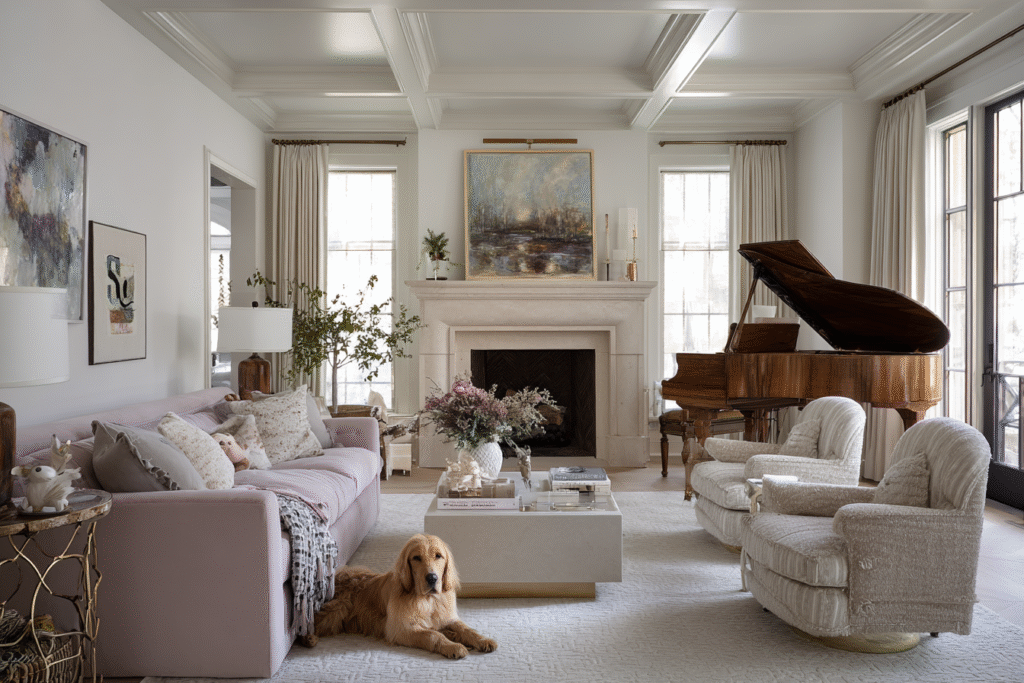
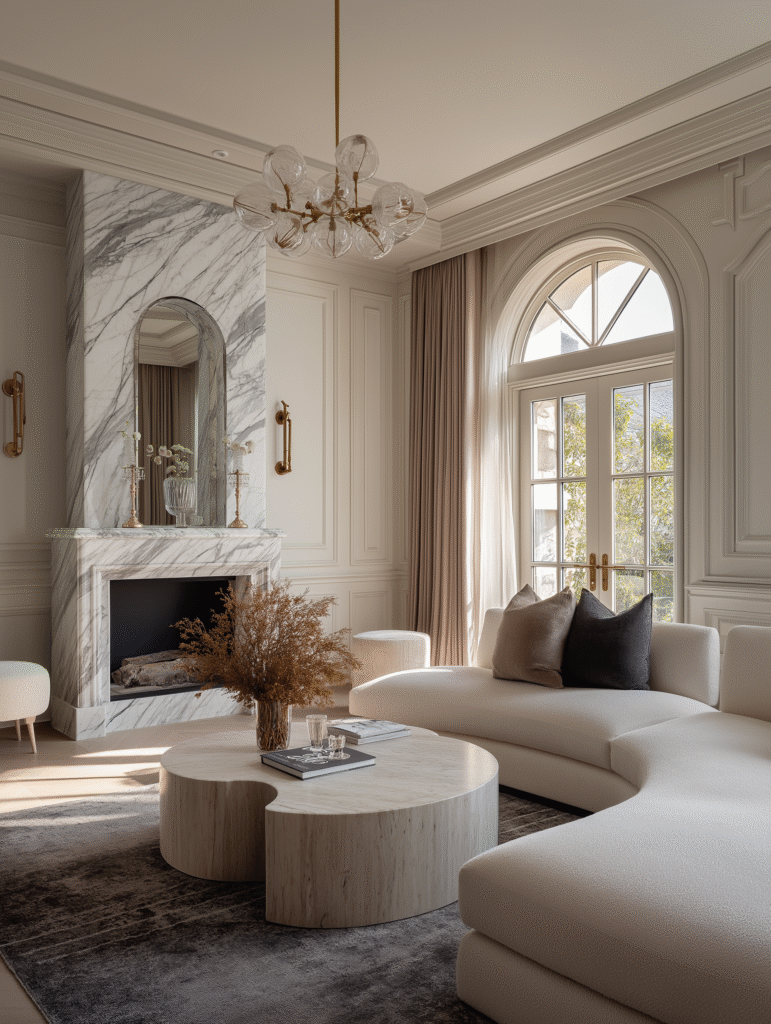
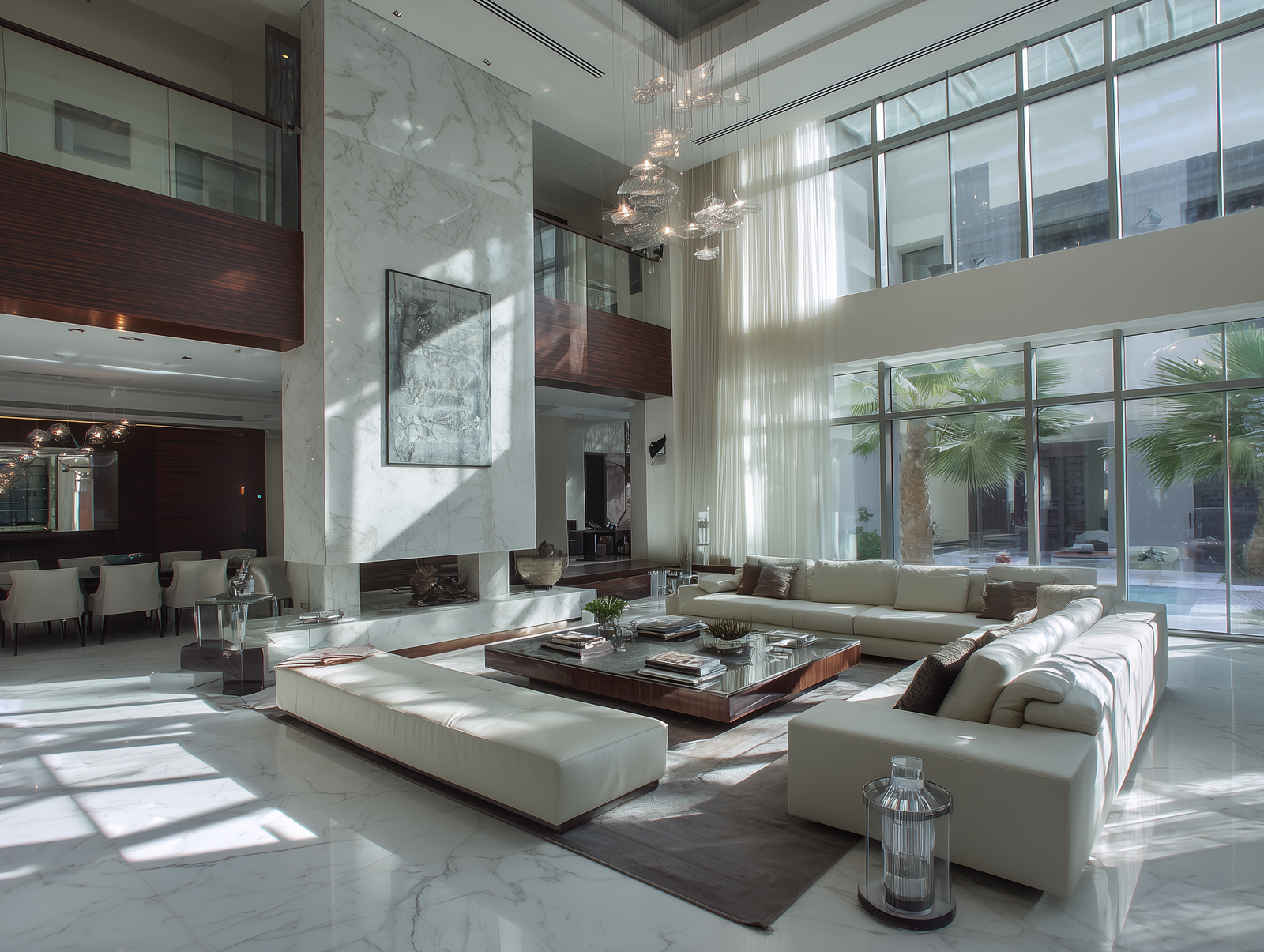
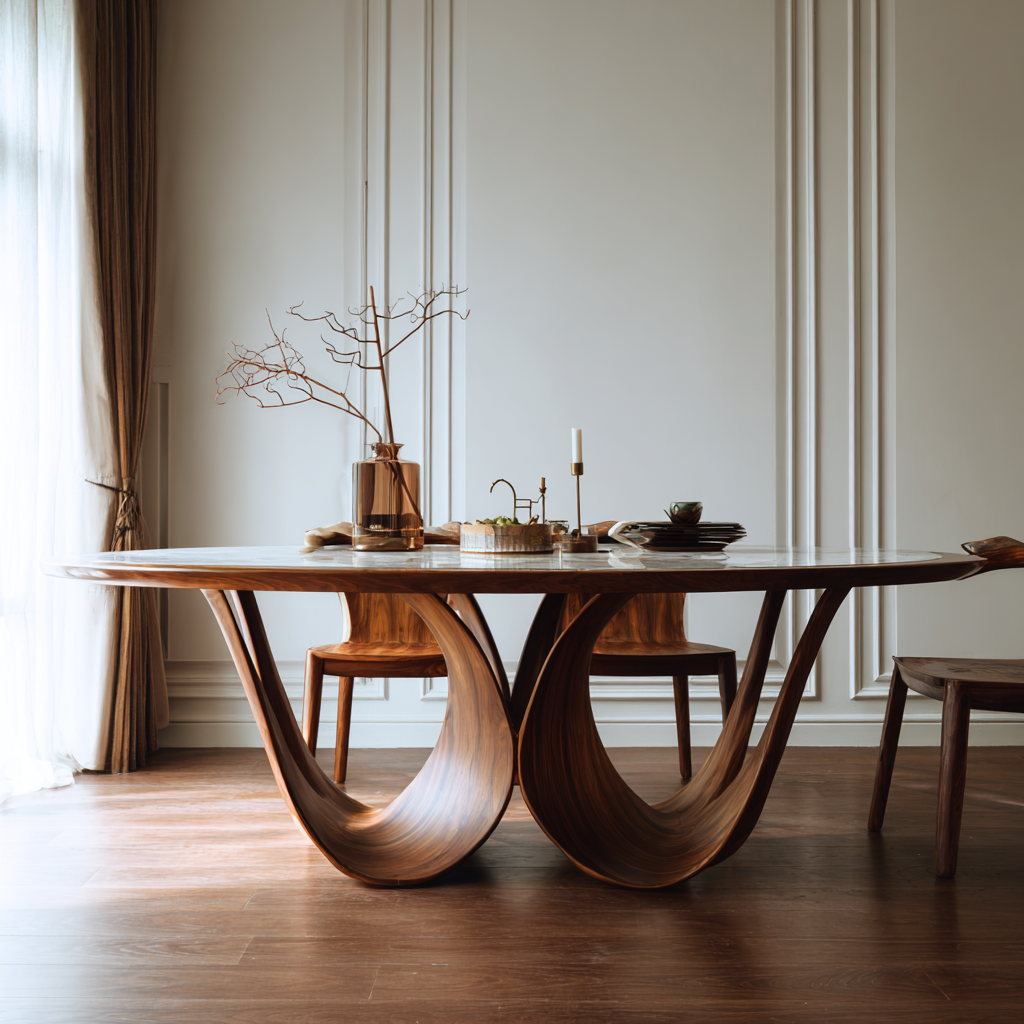
Interior design statistics UK 2026 showing a luxury living room with designer furniture, lighting and home décor trends


Interior design in the UK is no longer treated as something reserved only for large homes, luxury hotels or full-scale renovation projects. In 2026, it sits at the centre of how people think about comfort, identity, property value and everyday living.

After several years of economic pressure, homeowners are more cautious with discretionary spending. Yet the home remains one of the few areas where people continue to invest with purpose. The latest data suggests that many UK consumers are not simply buying more; they are making more considered decisions. They want homes that work better, look better and feel more personal.

That shift matters for interior designers, furniture retailers, home décor brands, architects, renovation professionals and homeowners. A design-led home is not created by one purchase. It is shaped by renovation choices, room layout, lighting, colour, furniture, storage, materials and the way people actually live in the space.

This report brings together the most useful interior design statistics for the UK in 2026, using credible data from sources including IBISWorld, Houzz, the Office for National Statistics, Deloitte, KPMG, Aviva, RIBA and the 2025 Houzz UK State of the Industry Report.

Rather than listing hundreds of disconnected figures, this article focuses on the statistics that explain what is happening in the UK interiors market: how large the industry is, how consumers are behaving, how renovation is shaping demand, how online shopping influences interiors, and which home design trends are most relevant in 2026.

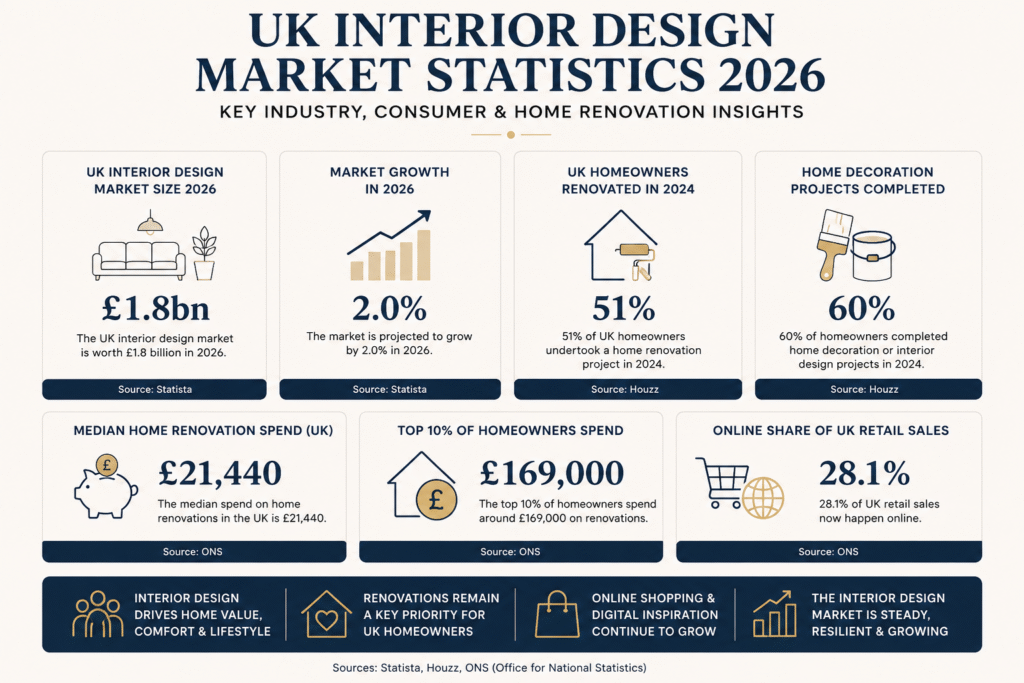
UK interior design market statistics 2026 infographic showing market size, renovation spend and online retail data

Key UK Interior Design Findings for 2026

The interior design statistics in the UK market remains resilient, even though consumers are cautious. According to IBISWorld, the UK interior design activities market is worth £1.8 billion in 2026. The same source reports that the market increased by 2.0% in 2026 and grew at a 1.8% compound annual growth rate between 2021 and 2026.

That growth is not dramatic, but it is meaningful. Interior design is a discretionary service. People do not usually hire an interior designer, renovate a room or replace major furnishings unless they feel there is a strong reason to do so. A growing market suggests that better-designed homes are still a priority for many households, even when budgets are under pressure.

The renovation data is even stronger. The 2025 UK Houzz & Home Renovation Trends Study found that 51% of surveyed UK homeowners renovated their homes in 2024, while 60% completed decoration projects. Median renovation spend rose by 26% year on year to £21,440, and the top 10% of renovating homeowners spent £169,000.

That tells us something important about the interiors market. While some households are reducing discretionary spending, another group is still investing heavily in the home. This creates a split market: cautious consumers at one end and serious home improvers at the other.

Professional involvement is also high. Houzz found that 94% of renovating homeowners worked with at least one professional. Electricians were used by 59%, plumbers by 56%, painters by 41%, architects by 25% and cabinetry professionals by 27%. This matters because interior design does not exist separately from renovation. The final look of a room depends on lighting, layout, joinery, colour, materials and furniture working together.

Online behaviour is also shaping the industry. The ONS April 2026 retail sales bulletin reported that online sales accounted for 28.1% of total UK retail sales in April 2026, while online sales values were 6.6% higher than in April 2025. Interior design decisions are now heavily influenced by online research, visual inspiration and ecommerce product discovery.

The overall picture is clear: interior design in the UK is becoming more practical, more research-led and more personal. Consumers want homes that look good, but they also want spaces that function better for modern life.

How Big Is the UK Interior Design Market?

The UK interior design industry is a billion-pound market. IBISWorld estimates the market size of interior design activities in the UK at £1.8 billion in 2026, with a 2.0% increase in market size during the year. It also reports that the market has grown at a 1.8% compound annual growth rate between 2021 and 2026.

This is important because the market has not had easy conditions. Cost-of-living pressures, inflation and weaker consumer confidence have affected spending on non-essential services. Interior design can be postponed when household budgets tighten, so continued growth suggests that many homeowners and businesses still see design as valuable.

There is also a difference between professional interior design and interior design behaviour. Not every homeowner hires a designer, but many now behave more like design-conscious consumers. They research colour palettes, compare room layouts, study materials, save inspiration images and look for furniture that completes a specific atmosphere.

This wider design awareness is one of the biggest changes in the market. A homeowner may not use a professional designer, but they still want a home that feels considered. They may search for warm neutral living rooms, modern traditional interiors, quiet luxury bedrooms, dining room lighting ideas or small hallway mirror ideas before buying anything.

This means the interior design market is larger than professional fees alone. It influences furniture, lighting, home décor, paint, flooring, textiles, fitted storage, kitchen design, bathroom upgrades and renovation services.

The 2025 Houzz UK State of the Industry Report shows that professionals in the renovation and design sector expected stronger conditions in 2025. Two in five industry professionals expected a good or very good year, while 57% anticipated revenue growth. Interior designers were among the most optimistic, with 44% reporting a good or very good outlook, 69% expecting revenue growth and 44% anticipating increased demand for their services.

This suggests that professional design services remain relevant, especially for homeowners who want help making expensive decisions. Interior designers do not simply choose colours and cushions. They help clients avoid costly mistakes around layout, scale, lighting, materials and furniture selection.

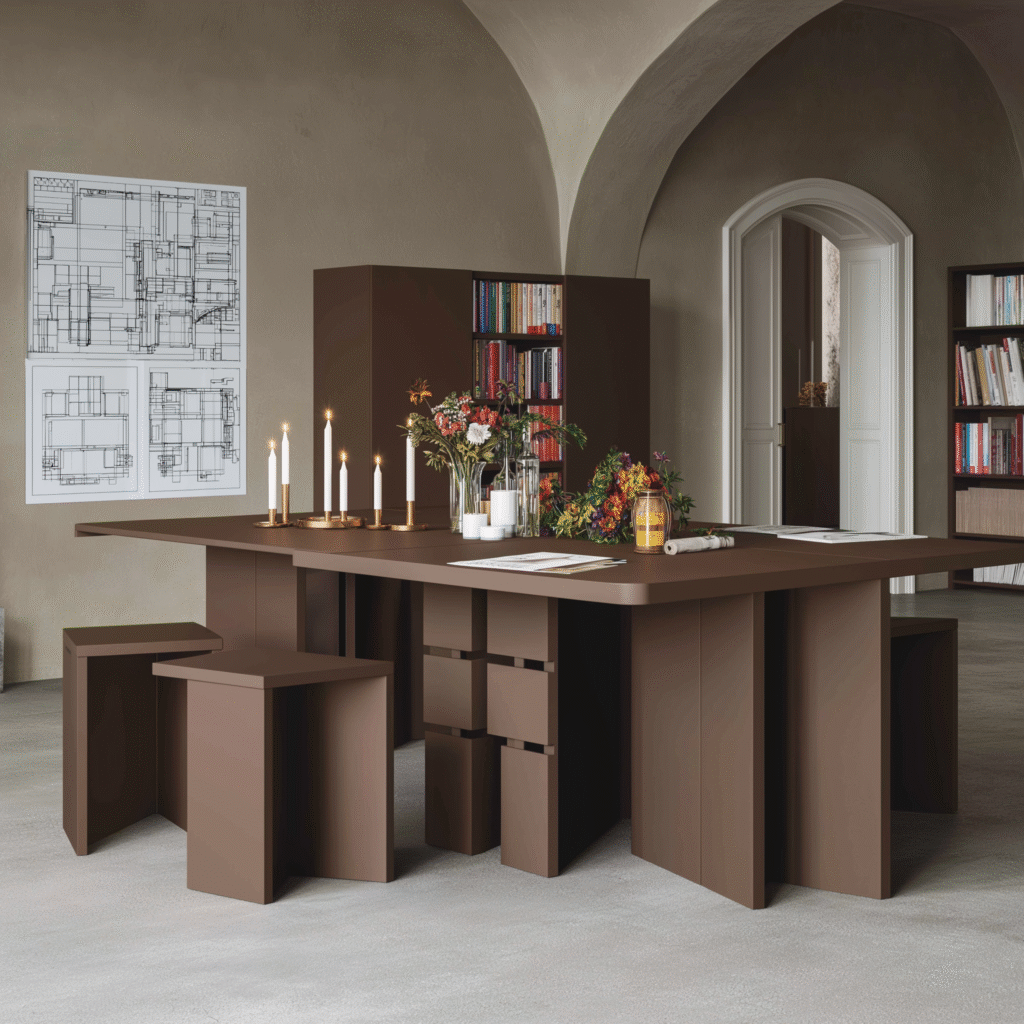
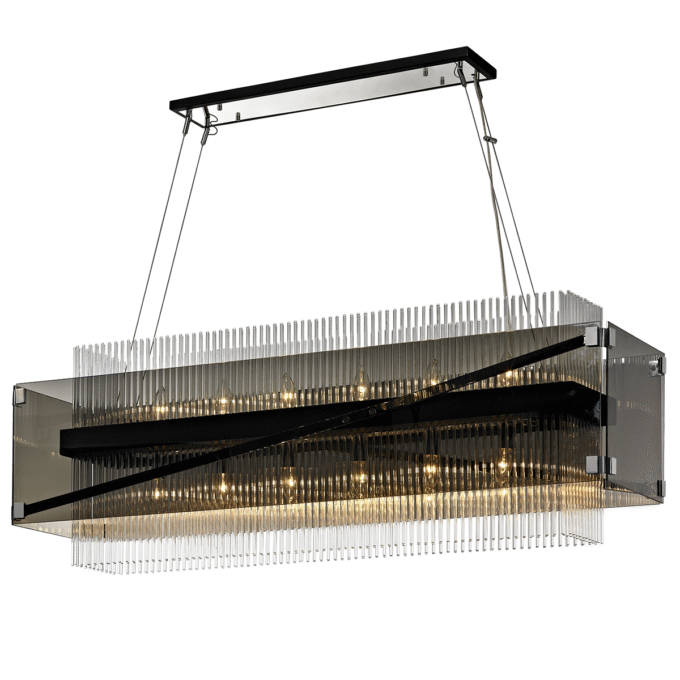
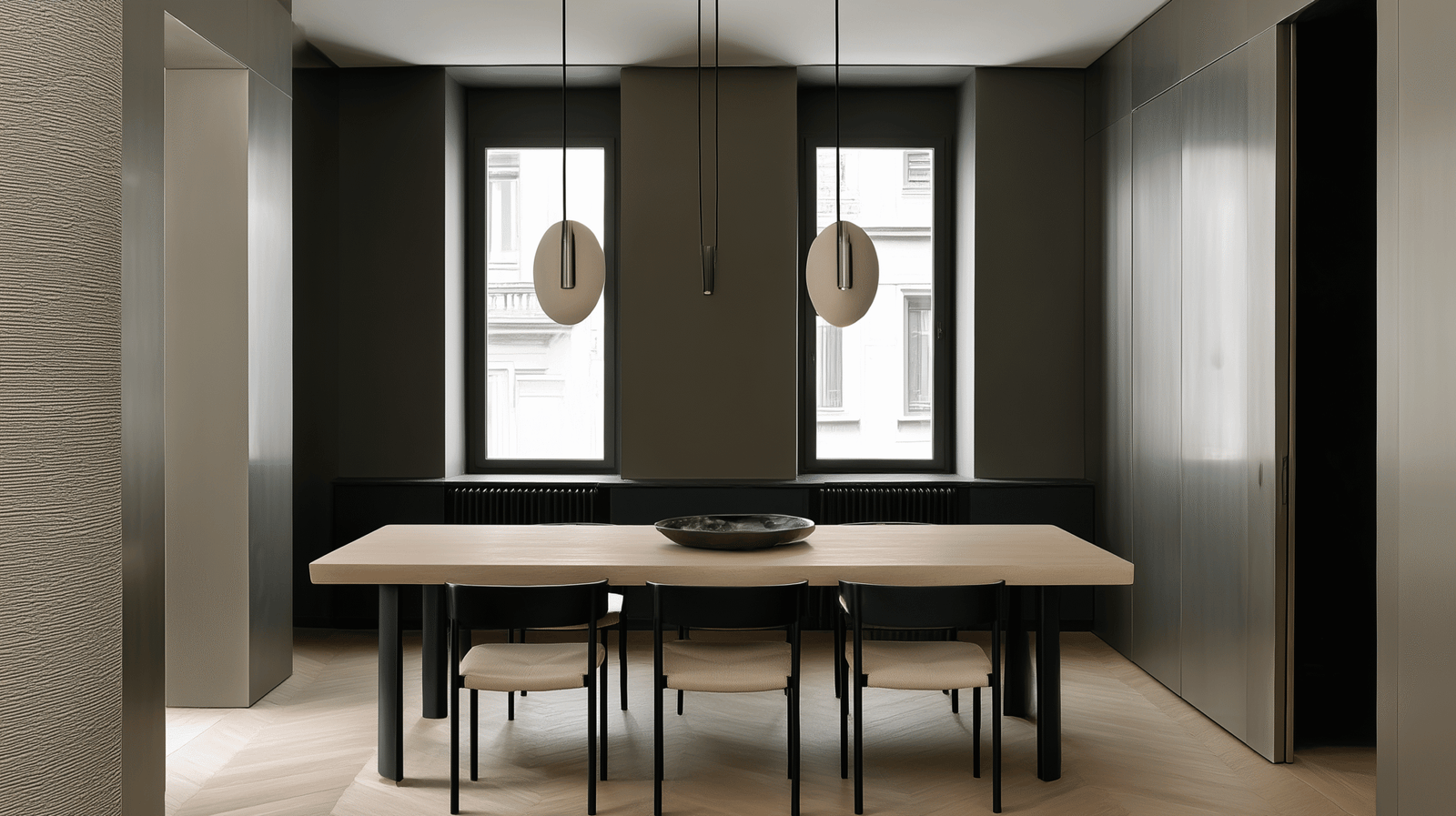
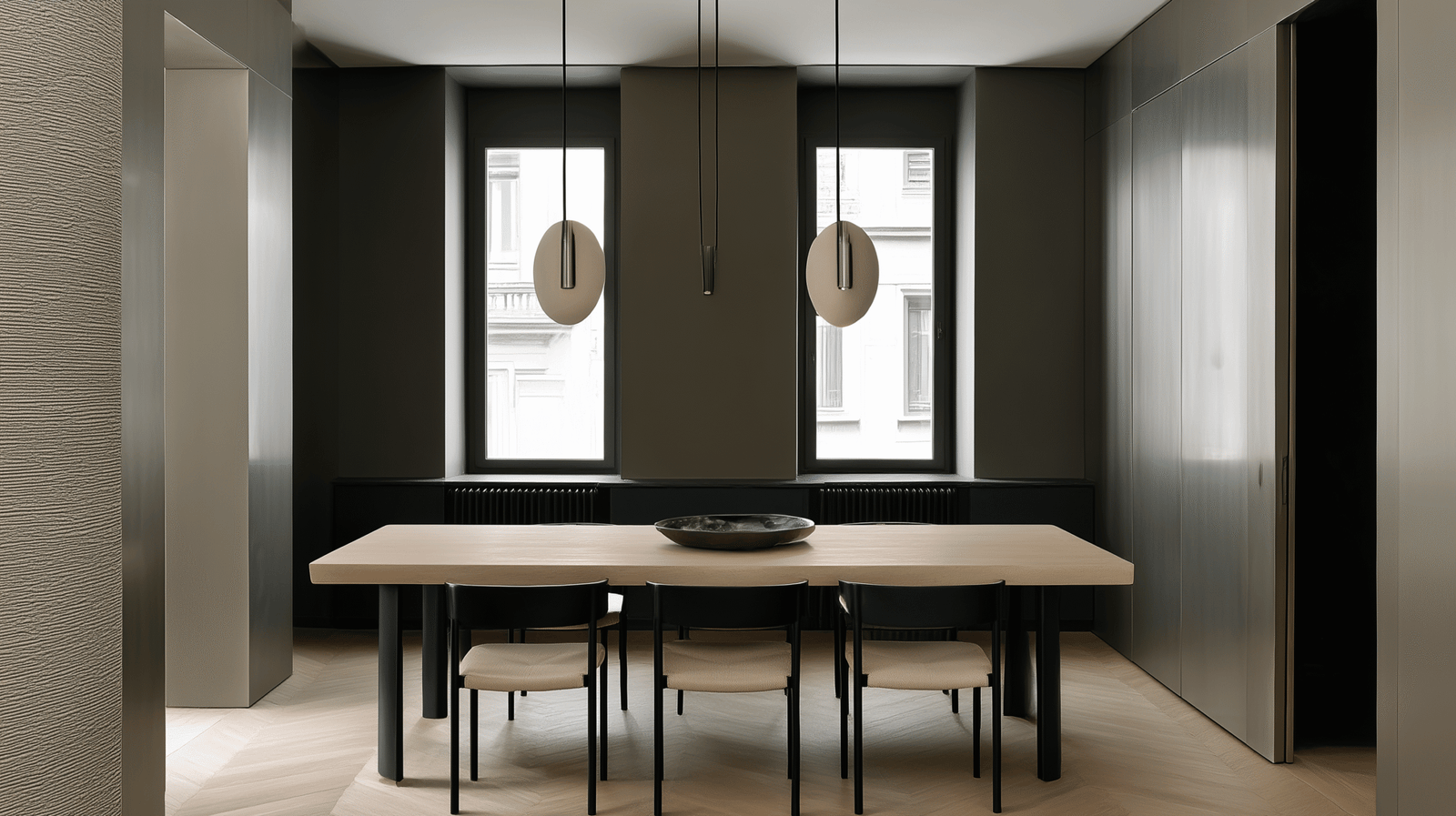
UK home renovation and interior design trends showing a renovated dining room with luxury furniture and statement lighting

Consumer Confidence and Interior Spending in 2026

The interior design market is growing, but consumer behaviour is cautious.

Deloitte’s Consumer Tracker for Q1 2026 reported that discretionary spending reached a three-year low, falling by seven percentage points to its lowest level since Q1 2023. Deloitte also reported one of the largest drops in consumer confidence since the pandemic period.

KPMG’s Consumer Pulse Q1 2026 also shows a cautious mood. In March 2026, 62% of UK consumers said they felt the economy was worsening, up from 58% in December. At the same time, more than half said they still felt financially secure. This is the tension shaping interiors in 2026: consumers may feel personally stable, but uncertain about the wider economy.

For interiors, this creates a more selective buyer. People still care about improving their homes, but they want purchases to feel justified. A new dining table, sofa, sideboard, mirror or lighting scheme must solve a real problem. It must make the room more comfortable, more useful or more beautiful.

This explains why “considered interiors” are becoming more important than fast interiors. Buyers are less interested in replacing everything quickly and more interested in pieces that feel durable, flexible and timeless. A beautiful home is still desirable, but the route to achieving it has become more careful.

The result is a market where design advice matters. Consumers want to understand why one piece works better than another. They want guidance on scale, proportion, colour, materials, lighting and room function. Interior design content now plays a commercial role because it helps people feel confident enough to spend.

Home Renovation Statistics and Interior Design Demand

Home renovation is one of the strongest drivers of interior design demand in the UK.

According to the 2025 UK Houzz & Home Renovation Trends Study, 51% of surveyed UK homeowners renovated their homes in 2024. Decoration was even more common, with 60% completing decoration projects. That is significant because decoration is where many interior design decisions happen: paint colours, furniture, lighting, curtains, mirrors, rugs, styling and room atmosphere.

Houzz also found that median renovation spend rose by 26% year on year to £21,440. The top 10% of renovating homeowners spent £169,000. This demonstrates that while some consumers are cautious, committed renovators are still spending heavily.

The same study found that 49% of surveyed homeowners planned to renovate in 2025, while 60% planned to decorate. That means the pipeline of interior-related work remains active. Even if not every project is large, many homes are still being updated.

Aviva’s How We Live report adds another useful perspective. It found that almost seven million UK homeowners planned to renovate their homes and intended to spend more than £14,000 each on average over the next two years. Renovation plans were especially popular among younger homeowners, with 73% of Generation Z homeowners and 65% of Millennial homeowners planning work.

This is important because younger homeowners are often highly design-aware. They are used to researching online, comparing inspiration images and thinking carefully about how rooms look in photos as well as in everyday life. Their renovation choices are often shaped by social media, Pinterest, property programmes, online magazines and visual search.

Renovation also changes what people buy. A newly painted room can make an old sofa look tired. A new kitchen can make existing dining chairs feel wrong. New flooring can expose the need for a better rug, coffee table or sideboard. New lighting can change the atmosphere of a room completely.

Interior design demand is therefore not limited to people hiring designers. It includes anyone trying to make the finished room feel coherent after investing in renovation work.

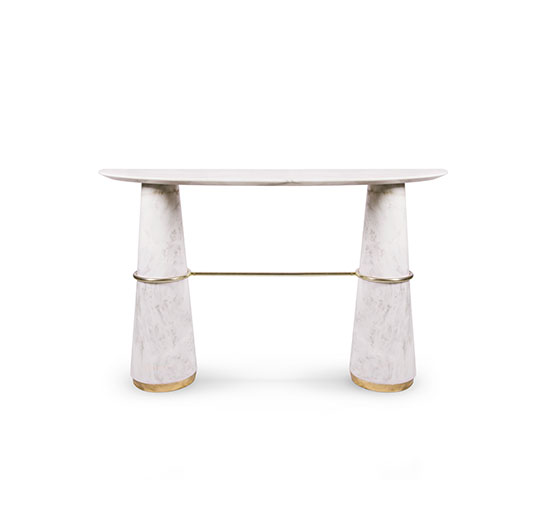
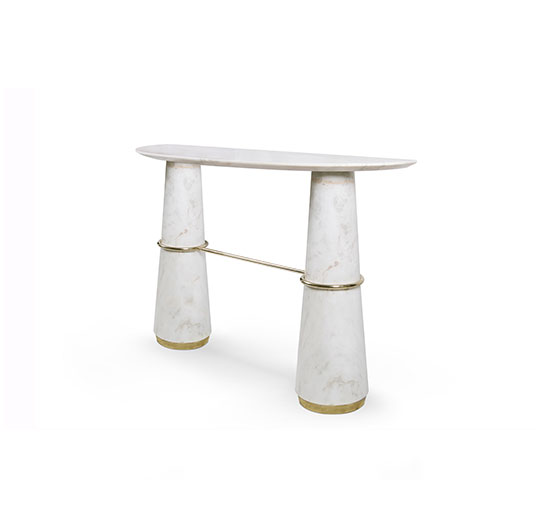
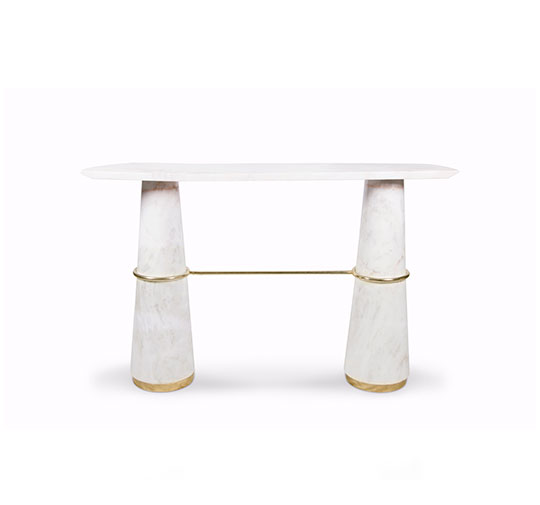
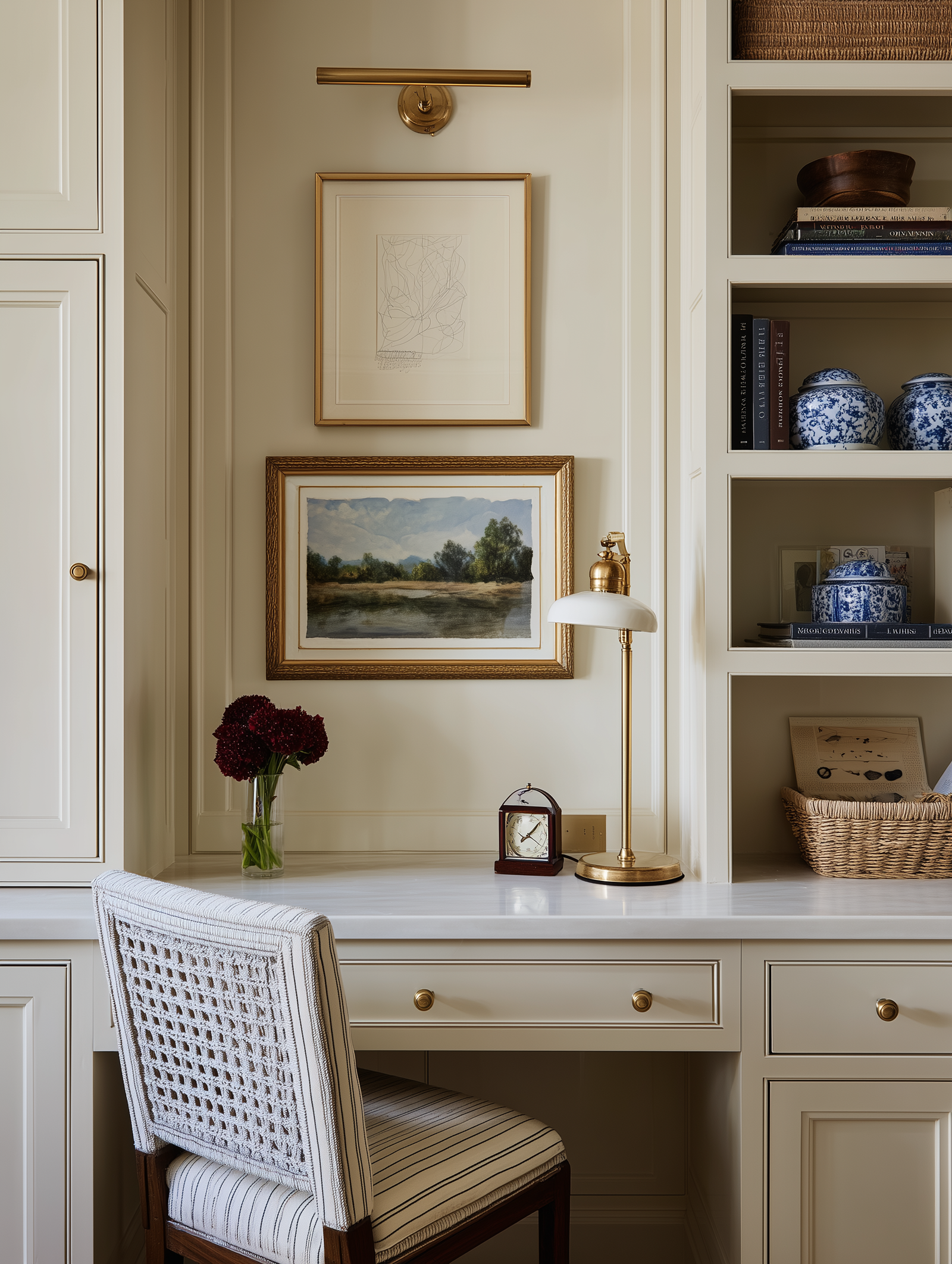
Luxury interior design insights UK showing a finished hallway with console table, mirror, lighting and elegant home décor

Professional Services and the Role of Interior Designers

The renovation market is highly professionalised. Houzz found that 94% of renovating homeowners worked with at least one professional in 2024. Electricians were used by 59%, plumbers by 56%, painters by 41%, architects by 25% and cabinetry professionals by 27%.

These figures matter because interior design depends on more than decoration. A room can have beautiful furniture and still fail if the lighting is wrong, the storage is poor, the layout does not work or the proportions feel unbalanced.

Interior designers sit between the practical and the aesthetic. They consider how a space functions, how people move through it, how natural light behaves, where sockets and lighting should be placed, how furniture sits in relation to architecture, and how materials work together.

This is especially relevant in older UK homes. Houzz found that 53% of renovating homeowners lived in homes built in 1940 or earlier. Older homes often have character, but they can also have awkward layouts, small rooms, low light, uneven floors or period details that need sensitive treatment.

Good interior design can help these homes feel modern without stripping away their character. Instead of forcing every period property into a generic contemporary style, designers often use layered lighting, thoughtful furniture, natural materials, mirrors, rugs and colour to make older homes feel both practical and atmospheric.

The RIBA Homeowner Survey also shows how much homeowners care about the way space works. Nearly a quarter of homeowners said they would reconfigure existing spaces, while a fifth wanted to create more space by extending their home. RIBA also found that 40% wanted more environmental design features, including better natural daylight, improved energy efficiency and better soundproofing between spaces.

Those findings remain relevant because they show that interior design is not just about appearance. People want homes that feel lighter, calmer, more efficient and better suited to real life.


Online Interior Design and Digital Shopping Behaviour

Interior design has become deeply digital.

The ONS reported that online sales accounted for 28.1% of total UK retail sales in April 2026. Online sales values were 6.6% higher than in April 2025, even though they fell by 2.3% month on month. The share of online sales had reached 28.7% in March 2026 before falling slightly in April.

For interiors, this matters because online behaviour often starts long before a purchase. A person may search for design ideas weeks or months before buying a chair, table, lamp or mirror. They may save inspiration, compare colours, check measurements, read guides and look at several retailers before making a decision.

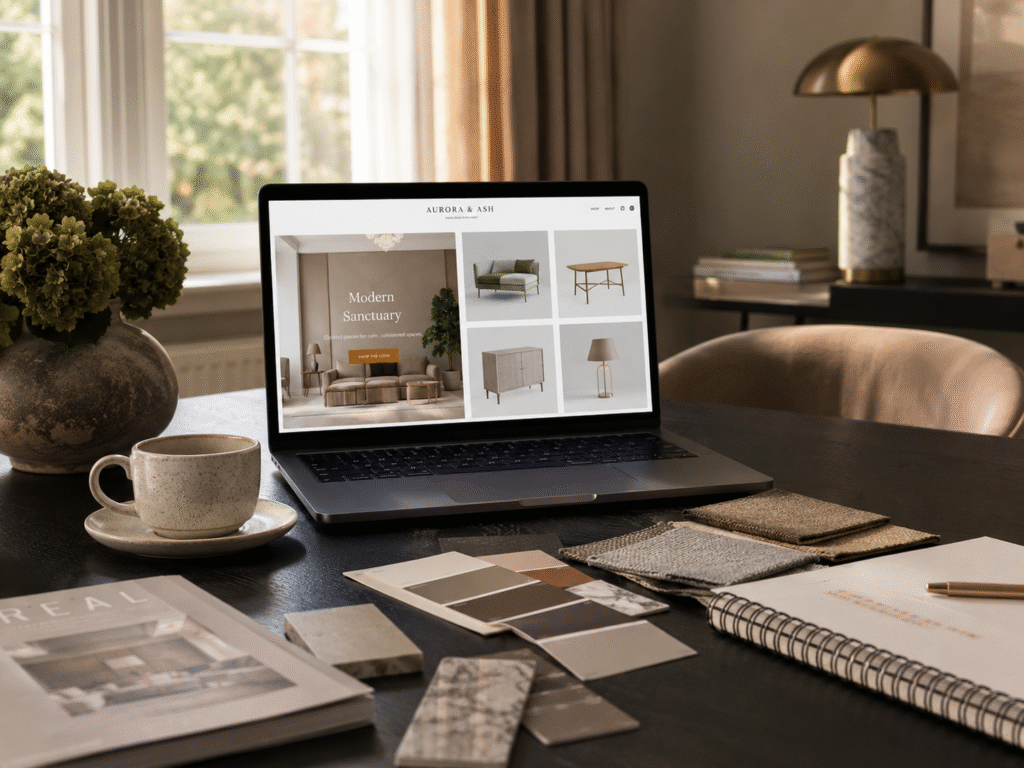
This has changed the customer journey. Interior design used to be more dependent on showrooms, magazines and professional consultations. Those still matter, but online search now plays a huge role in shaping taste. Consumers can discover a trend, compare products and make a purchase from the same device.

It also means that content is part of the design process. A well-written guide on choosing dining chairs, styling a console table, selecting bedroom lighting or decorating a small living room can influence what the customer buys. The most useful interiors content does not simply show products; it helps people make decisions.

This is why online interior design behaviour is not just about ecommerce. It is about confidence. Many interiors purchases are visual and emotional, but they also involve practical questions. Will the table fit? Is the chair the right height? Will the mirror make the room feel brighter? Is the fabric practical? Will the light be too low over the dining table?

The brands, designers and retailers that answer those questions clearly are more likely to earn trust.

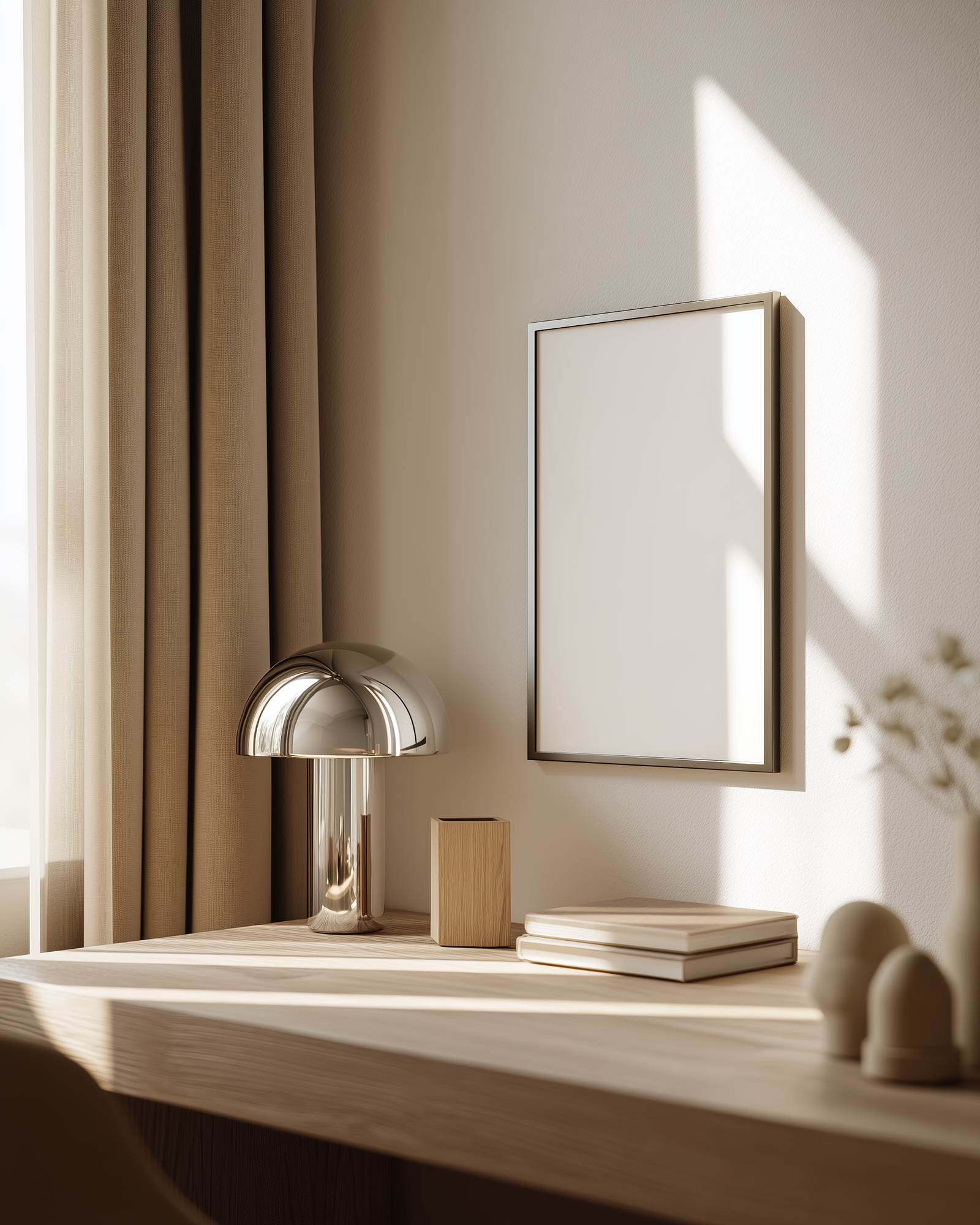
Interior design trends UK 2026 showing quiet luxury interiors, warm neutrals, statement lighting and natural materials

Interior Design Trends Shaping UK Homes in 2026

The strongest interior design trends in 2026 are not about novelty. They are about comfort, character and longevity.

One of the biggest shifts is the move away from cold, flat interiors. Grey and white schemes are being replaced by warmer tones: cream, taupe, olive, terracotta, chocolate brown, muted gold, burgundy and soft green. These colours feel more lived-in and more forgiving than the cooler palettes that dominated many homes over the past decade.

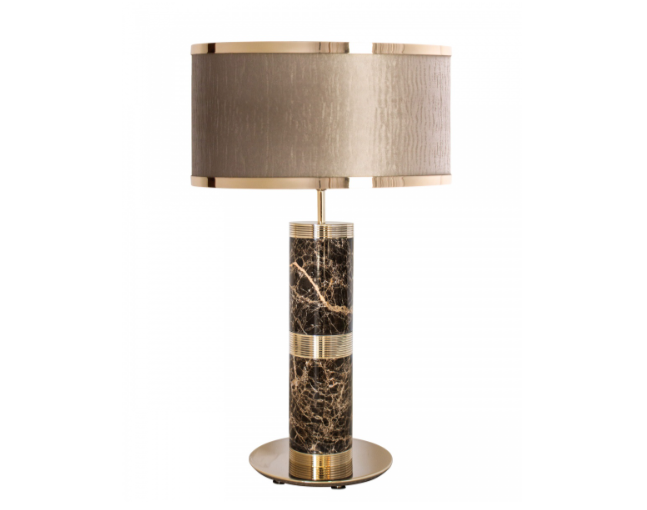
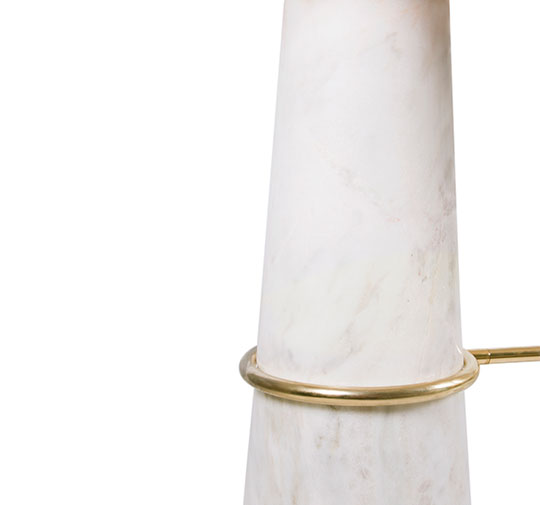
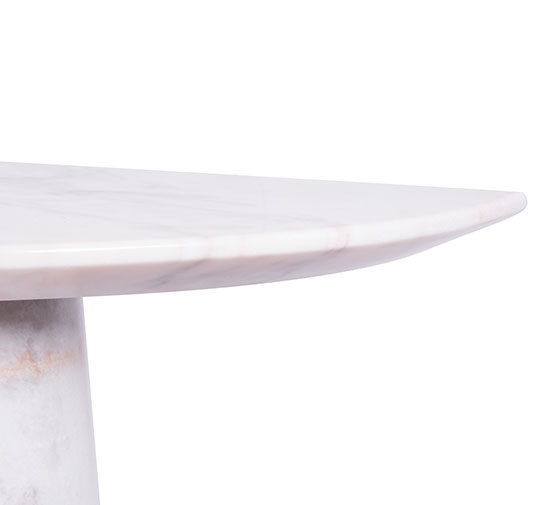
Natural materials are also central. Wood, marble, travertine, linen, wool, leather, stone, brass and bronze are all associated with interiors that feel grounded and timeless. The appeal is not only visual. These materials add texture, depth and tactility.

Quiet luxury remains influential. In interior design, quiet luxury means a room that feels refined without looking overly staged. It is less about obvious status and more about proportion, finish, comfort and restraint. A quiet luxury room may use simple shapes, but the details matter: the curve of a chair, the weight of a curtain, the quality of a table, the warmth of a lamp.

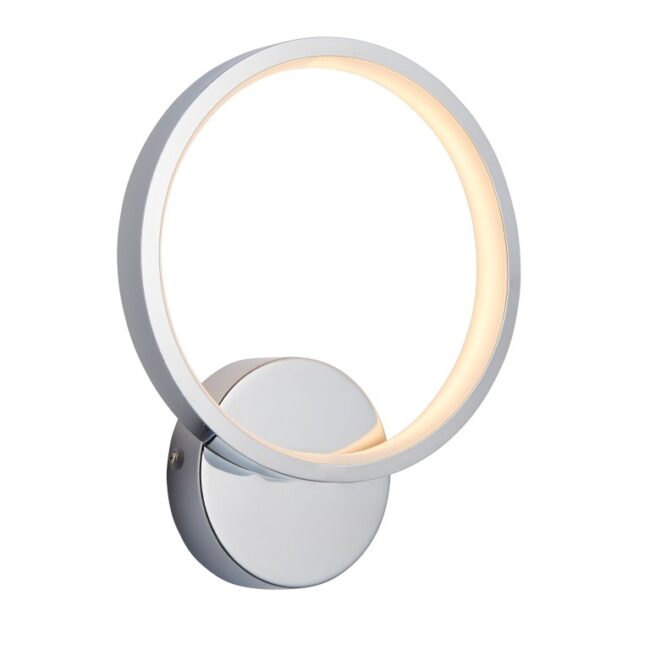
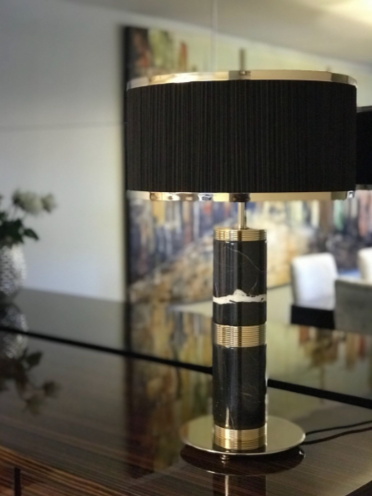
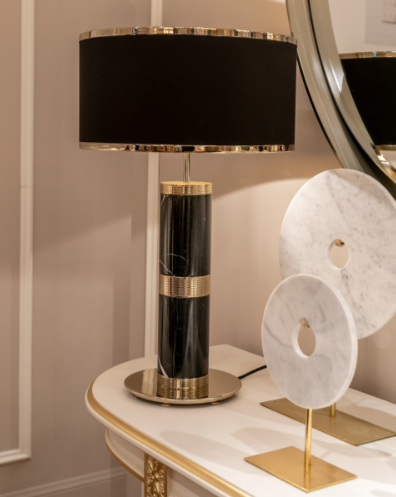
Layered lighting is another major trend. More homeowners are realising that a room cannot rely only on ceiling lights. Table lamps, wall lights, picture lights, floor lamps and pendants create atmosphere. Lighting can make a space feel warmer, softer and more expensive without changing the entire room.

Storage is also becoming more design-led. As homes work harder, visible clutter becomes more frustrating. Built-in joinery, sideboards, cabinets, media units and bedroom storage are all part of the interior design conversation because they affect how calm a room feels.

There is also growing interest in homes that feel collected rather than copied. Matching furniture sets are less desirable than layered interiors that mix materials, periods, colours and textures. A home that combines antique influence, modern comfort and personal details often feels more sophisticated than one designed around a single trend.

The final trend is practicality. Interiors must look good, but they must also support daily life. Dining spaces need comfortable chairs. Living rooms need tables that work with sofas and rugs. Bedrooms need calm lighting and storage. Hallways need mirrors, consoles and practical surfaces. Interior design in 2026 is about beauty, but it is also about usability.

What These Statistics Mean for Homeowners and Interior Brands

The data suggests that UK interior design is moving into a more thoughtful phase.

Homeowners still want attractive spaces, but they are less likely to spend casually. They want design decisions that feel worthwhile. They want rooms that solve problems: poor lighting, awkward layouts, lack of storage, tired furniture, uncomfortable dining areas or spaces that do not reflect their taste.

For interior designers, this creates an opportunity to position design as a practical investment rather than a luxury extra. Good design can help homeowners avoid expensive mistakes. It can make a home easier to live in, more comfortable to host in and more emotionally satisfying.

For interiors brands and retailers, the message is equally clear. Customers need more than product listings. They need inspiration, explanation and reassurance. They want to understand scale, material, colour, finish and room placement. They want to see how items work in real spaces.

For homeowners, the best approach is to think beyond individual purchases. A beautiful room is rarely built from isolated items. It comes from the relationship between furniture, lighting, storage, colour, texture and proportion. That is why the most successful interiors in 2026 are likely to be layered, personal and practical.

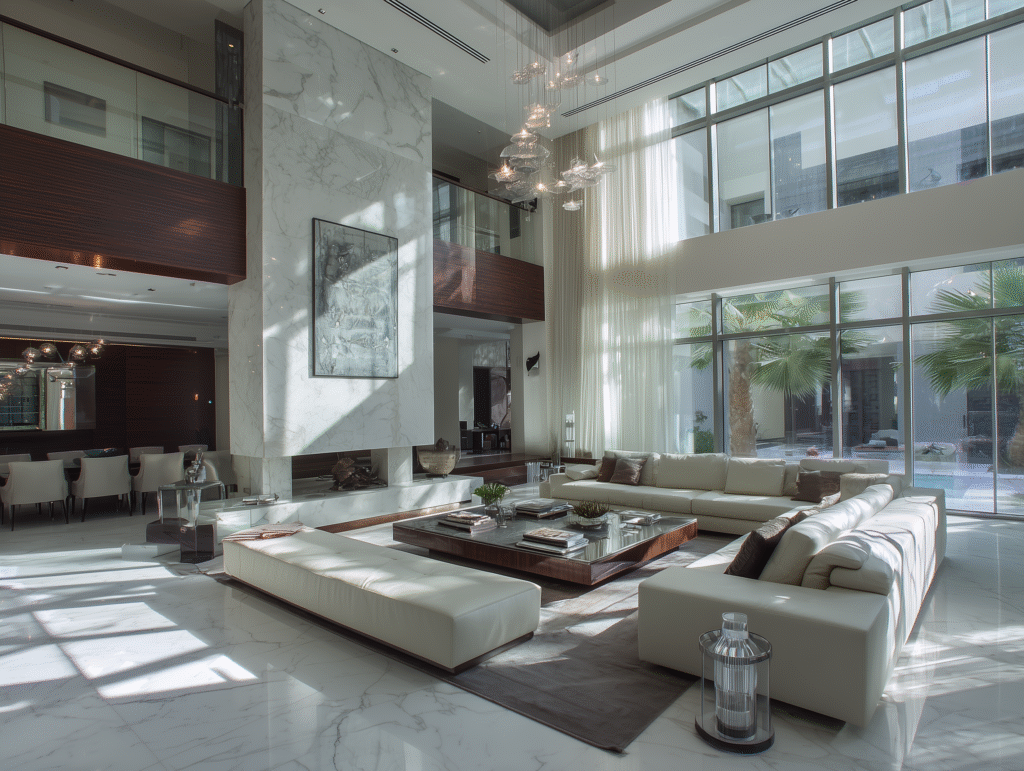
 

Elegant modern living room design

FAQs


How big is the UK interior design market in 2026?

According to IBISWorld, the UK interior design activities market is worth £1.8 billion in 2026. The market increased by 2.0% in 2026 and grew at a 1.8% compound annual growth rate between 2021 and 2026.
Is interior design growing in the UK?

Yes, but growth is moderate rather than explosive. The market remains affected by consumer confidence and discretionary spending pressures, but renovation activity and design awareness continue to support demand.

How much are UK homeowners spending on renovation?

Houzz found that median renovation spend rose by 26% year on year to £21,440 in 2024. The top 10% of renovating homeowners spent £169,000.

Are UK homeowners still renovating?

Yes. Houzz found that 51% of surveyed UK homeowners renovated their homes in 2024, while 60% completed decoration projects. Almost half planned to renovate in 2025, and 60% planned to decorate.

Why does renovation matter for interior design?

Renovation often creates new design needs. Once a room has new flooring, paint, lighting or layout changes, homeowners usually need furniture, lighting, storage and decorative pieces that match the new space.

How important is online shopping for interior design?

Online shopping and online research are very important. ONS data shows that online sales accounted for 28.1% of total UK retail sales in April 2026. Many interior decisions now begin with online searches, inspiration boards, guides and product comparisons.

What are the biggest interior design trends in the UK for 2026?

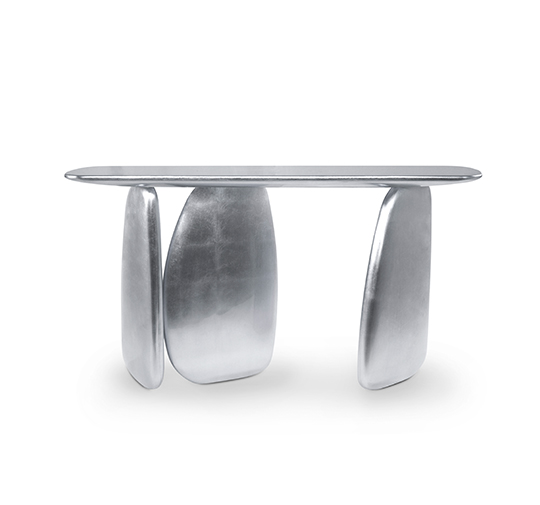
The biggest trends include warm neutrals, quiet luxury, layered lighting, natural materials, sculptural furniture, better storage, period-property sensitivity and homes that feel collected rather than overly matched.


Sources and Methodology

This article uses publicly available UK interior design, renovation, retail and consumer behaviour data. Main sources include:

Where there is no single official statistic for the full “interior design influence” market, this article uses related indicators including professional interior design market size, renovation spending, decoration activity, online retail behaviour and consumer confidence to understand demand in the UK interiors sector.

What do you think?
Leave a Reply

Blog

Get fresh home inspiration and helpful tips from our interior designers

top
1
    1
    Your Cart
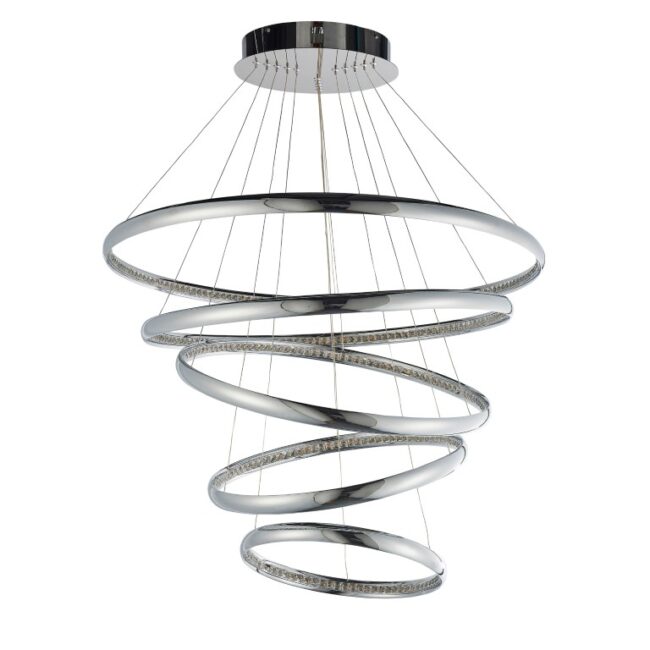
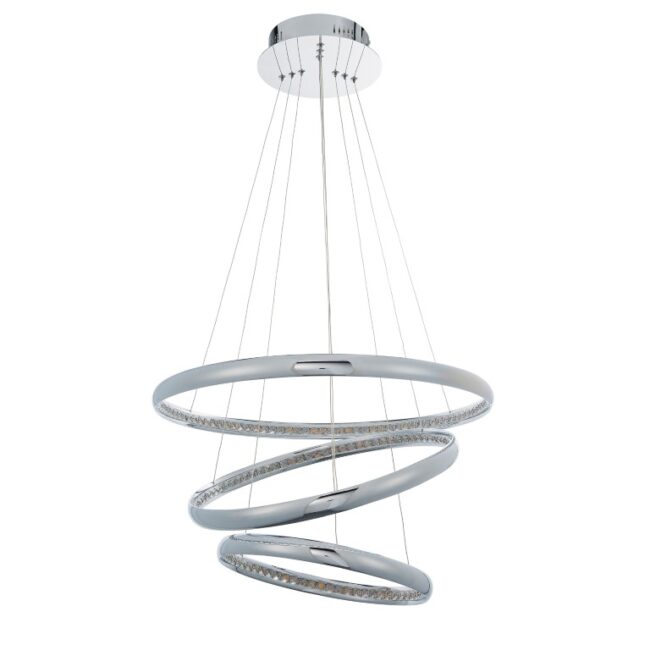
    Apogee Pendant Remove
    Apogee Pendant
    Qty: 1
    Price: £324
    £324

    Inactive

    Privacy Overview

    This website uses cookies so that we can provide you with the best user experience possible. Cookie information is stored in your browser and performs functions such as recognising you when you return to our website and helping our team to understand which sections of the website you find most interesting and useful.